About Asymmetric Edge

A Simple Idea, Run With Discipline
I run a four-ETF portfolio. Once a month, I rebalance it. Each month I share exactly what I hold and why.
That's the whole pitch.
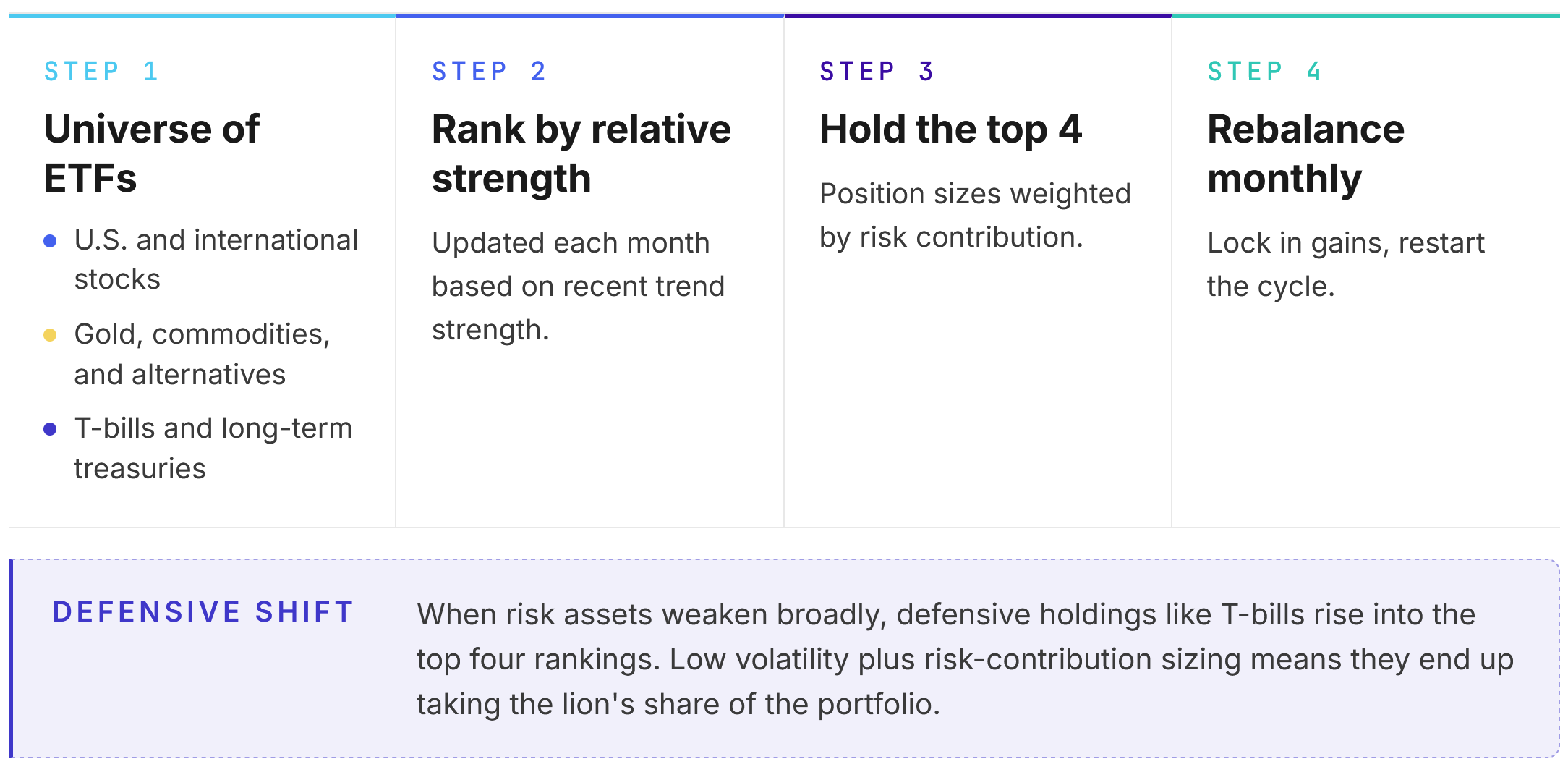
Behind that simple front end is a tested, rules-based system that rotates among ~10 ETFs spanning U.S. and international stocks, gold, broad commodities, bitcoin, and short and long Treasuries. The four assets with the strongest momentum take their place in the portfolio. When momentum across risk assets fades, the strategy shifts toward short-term Treasuries to protect capital.
I use this approach with my own money. I run the same one for my mother in her retirement. If it ever stops making sense for me, you'll be the first to know.
The Track Record so Far
Through May 8, 2026
Benchmarked against a traditional 80/20 portfolio (80% global stocks, 20% bonds). S&P 500 shown on the chart for additional context.
- Inception: January 2, 2024
- Total return since inception: 65.36% (vs. 43.98% for 80/20)
- Annualized return (CAGR): 24.06% (vs. 16.91% for 80/20)
- Maximum drawdown since inception: -12.79% (vs. -12.94% for 80/20)
- Sortino ratio: 4.17 (vs. 2.29 for 80/20)
Charting the Growth of $10,000
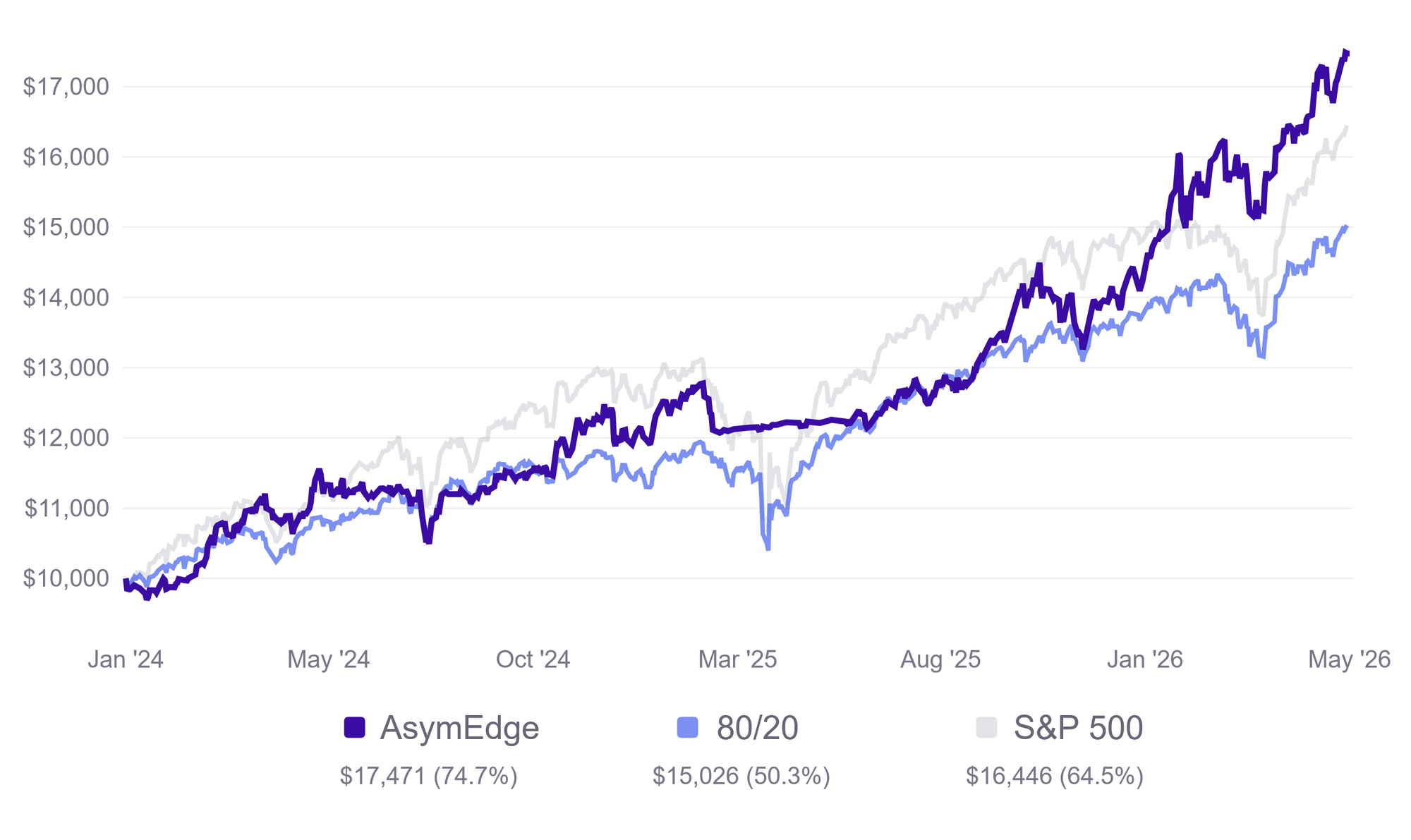
I show all of this because I want you to evaluate the work yourself. Not because I'm promising any of it will continue.
Who I Am
I'm Tyler Marshall. I live in Colorado, and I've spent the better part of a decade building, testing, and refining the system this newsletter documents.
My background sits at the intersection of business and behavior. I have a Master's in Accounting and have worked across sales, marketing, business development, and strategy consulting. I focused on investing full time from 2018 through 2023 and have continued running and refining my approach part time since.
I'm also finishing a Master's in Mental Health Counseling this fall and will be opening my own counseling practice later this year. That pivot might look unrelated to the investing work, but I'd argue it's the most relevant qualification I have for this newsletter.
The longer I've spent in markets, the more convinced I've become that understanding human psychology is the one persistent edge an investor can have. The strategies aren't secret. The data isn't proprietary. What separates good investors from anxious ones is what happens between their ears when prices move against them.
I'm not a financial advisor. I'm someone who's spent years trying to understand how money and minds interact, who got tired of watching the people I care about lose sleep over their portfolios, and who built a system designed to take some of that anxiety off the table.
Why I Started Writing This Newsletter
I've watched too many people, retirees especially, treat their investments like a thing to worry about rather than a thing to live with.
Checking balances every morning. Refreshing the news. Bracing for the next crash. Holding cash for years because they can't decide what to do with it. Switching strategies every time a friend mentions a hot stock or a podcaster sounds confident.
The cost of all that anxiety isn't just financial. It's the time and presence and peace of mind it takes from people. There's a quiet kind of grief in watching someone trade calm for chaos when they didn't have to.
I started Asymmetric Edge because I think there's a better way. Not a magic way. Not a guaranteed way. But a clearer, calmer, more disciplined way that I believe is well within reach for anyone who's curious enough to learn.
How It Works: Four Core Ideas
The strategy rests on four core ideas. Each one is straightforward on its own, and together they form the whole approach.
1. A broad asset universe, built for any environment
Most portfolios are some version of stocks and bonds. I don't think that's enough. Markets cycle through different economic environments, and a portfolio that only knows how to handle one of them is built to struggle in the others.
There are four basic environments, defined by whether economic growth is rising or falling and whether inflation is rising or falling.
Four Basic Economic Environments
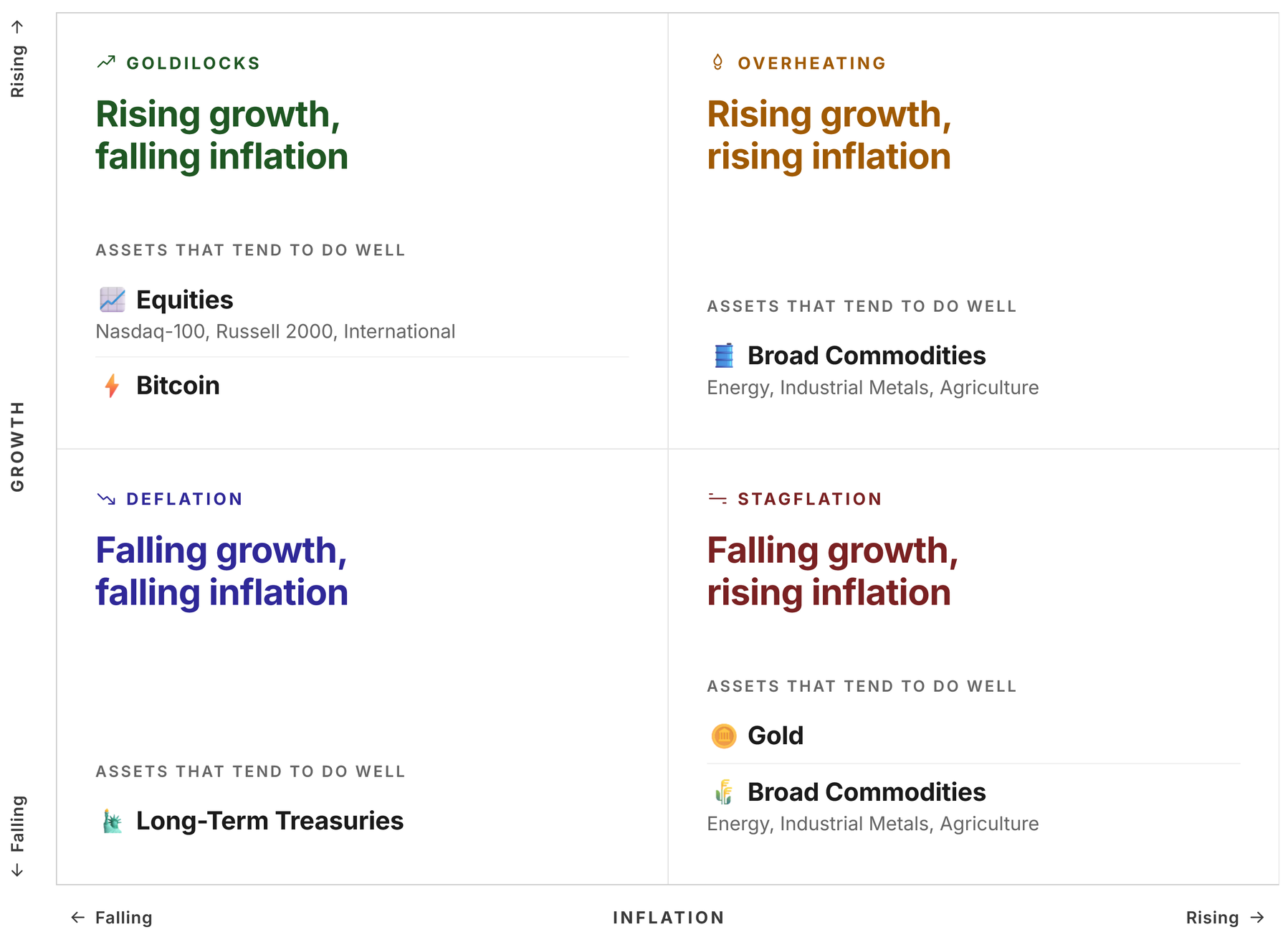
Goldilocks is rising growth with falling inflation. Equities tend to lead.
Overheating is rising growth with rising inflation. Commodities and inflation-sensitive assets tend to do well.
Stagflation is falling growth with rising inflation. Gold and commodities tend to hold up.
Deflation is falling growth with falling inflation. Long-term Treasuries tend to rally.
My universe of ~10 ETFs is built so that something is positioned for each of these environments. The strategy doesn't try to predict which one is coming next. It tracks momentum across the universe and shifts the portfolio toward whichever assets are leading.
2. Relative strength momentum
Markets trend. Assets that have been doing well tend to keep doing well over the medium term, until they don't. Each month, I rank the universe by momentum and hold the top four. When the rankings shift, the portfolio shifts.
3. A defensive rotation when momentum fades
This is the piece most momentum strategies miss, and it's a big reason I designed the system the way I did. When risk assets weaken across the board, short-term Treasuries climb into the rankings and the portfolio moves toward cash equivalents.
In early 2025, that mechanism pushed roughly 97% of the portfolio into Treasuries for three months and sidestepped most of the spring drawdown. The strategy is built to play offense when offense is working and defense when it isn't.
4. Position sizes based on risk contribution
Bitcoin, gold, and tech stocks all carry different levels of volatility. Equal-dollar weighting would let the most volatile asset dominate the portfolio. Instead, the strategy sizes positions so each contributes roughly the same amount of risk. Big bets on uncorrelated assets, kept in proportion.
My Investment Process
What Makes Asymmetric Edge Different
There's no shortage of investment content out there. A lot of it focuses on stock picks, big predictions, or static model portfolios that look the same in 2010 and 2025. This is meant to be different.
Simple to follow. Four ETFs. One rebalance per month. That's the entire workflow.
Adaptive. The strategy doesn't care what worked last year. It cares what's working now. If gold leads, it owns gold. If U.S. tech leads, it owns U.S. tech. If everything is breaking down, it owns Treasuries.
Built for staying power. My goal isn't to beat the S&P 500 every quarter. It's to match or exceed traditional balanced portfolios with meaningfully shallower drawdowns. Shallower drawdowns are what help normal people stay invested through hard markets.
Who This Is For
This is for someone who wants a thoughtful, rules-based approach without picking individual stocks. Someone who can hold a position through a 20% swing without abandoning the plan. Someone who wants to understand why they own what they own.
It's not for day traders. It's not a stock-tip service. It's not a path to overnight wealth. If you're looking for guaranteed returns, those don't exist, and anyone offering them is selling something other than honesty.
If you've been looking for a way to engage with your portfolio that doesn't feel like a second job, this might be a fit.
On Uncertainty
Investing is hard. No one, including me, knows what the market will do.
The best traders in the world are right about 51% of the time. They make money anyway because they cut losers quickly and let winners run. That's the asymmetry the name is borrowed from. The wins outweigh the losses not because the wins are more frequent, but because they're allowed to grow.
I've built a strategy I trust. I've stress-tested it across different market regimes. I'd never tell you it's certain to keep outperforming, because I don't know that, and you shouldn't believe anyone who claims they do.
What I can tell you is that I'll keep showing the results, good and bad. I'll keep refining the approach as I learn. And I'll keep treating you like an adult who can handle a real conversation about a real strategy.
If that's what you've been looking for, you're in the right place.
Asymmetric Edge is published by Peachy Portfolios LLC, a Colorado limited liability company.

Disclaimer & Disclosure
This newsletter is for informational purposes only and does not constitute financial advice, investment recommendations, or an offer to sell or buy any securities. The content is published as a journal of the author's personal investment activities and is intended for a general audience.
No Investment Advice: The author is not a financial advisor. You should not treat any opinion expressed herein as a specific inducement to make a particular investment or follow a particular strategy, but only as an expression of opinion.
Risk Warning: Investment involves risk, including the possible loss of principal. Past performance is not indicative of future results. No investment strategy or risk management technique can guarantee returns or eliminate risk in any market environment.
Data & Accuracy: Information contained herein has been obtained from sources believed to be reliable, but its accuracy and completeness are not guaranteed. All expressions of opinion are subject to change without notice in reaction to shifting market conditions.
Positions: The author currently holds positions in the securities mentioned in this newsletter. The author may buy or sell these securities at any time without notice.
Copyright: This content is provided solely for the personal use of the subscriber. Any unauthorized copying, forwarding, or distribution of this material is prohibited without prior written consent.